
Teak vs Bamboo Cooking Utensils: Which Is Better?
On a shelf, teak and bamboo kitchen tools look close to identical. Same warm colour, same smooth finish, often a noticeable gap in price. The teak vs bamboo cooking utensils question is really about what happens six months in, not about what you can see in the shop.
The two materials are not variations on the same thing. One is a hardwood cut from a tree. The other is a grass, sliced into strips and glued back together into something wood-shaped. That difference decides how each behaves at the sink, on a hot pan, and after a year of daily use.
The short answer
Teak, for anything you'll use every day.
Teak is solid hardwood with its own oil already in the grain, so it resists water without any coating. Most flat bamboo utensils are laminated strips held together with adhesive, and those glue lines are where they eventually come apart.
Handmade Teak Wood Kitchen Utensil Set — 6-Piece with Flip Tongs
Six pieces hand-carved from solid teak, natural and unvarnished.
The six pieces cost 47% less as a set than bought separately.
Handmade in Thailand · Dispatched from the UK · 30-day returns
Bamboo is a grass, and most bamboo utensils are glued
Bamboo isn't wood. It's a grass, and it grows as a hollow tube rather than a solid trunk. That matters more than it sounds, because you cannot carve a flat spatula out of a hollow tube.
So manufacturers don't. Culms are split lengthways into strips, planed flat, coated with adhesive and hot-pressed into a solid blank. The utensils are then cut from that blank. Pick up a bamboo spatula and look at the narrow edge — the fine parallel lines running its length are the seams between strips.
Reputable makers use food-grade adhesives, so this isn't a safety argument. It's a structural one. A laminated blank is only as sound as the bonds holding it together, and those bonds are the part water finds first.
Teak comes off the tree solid and stays solid
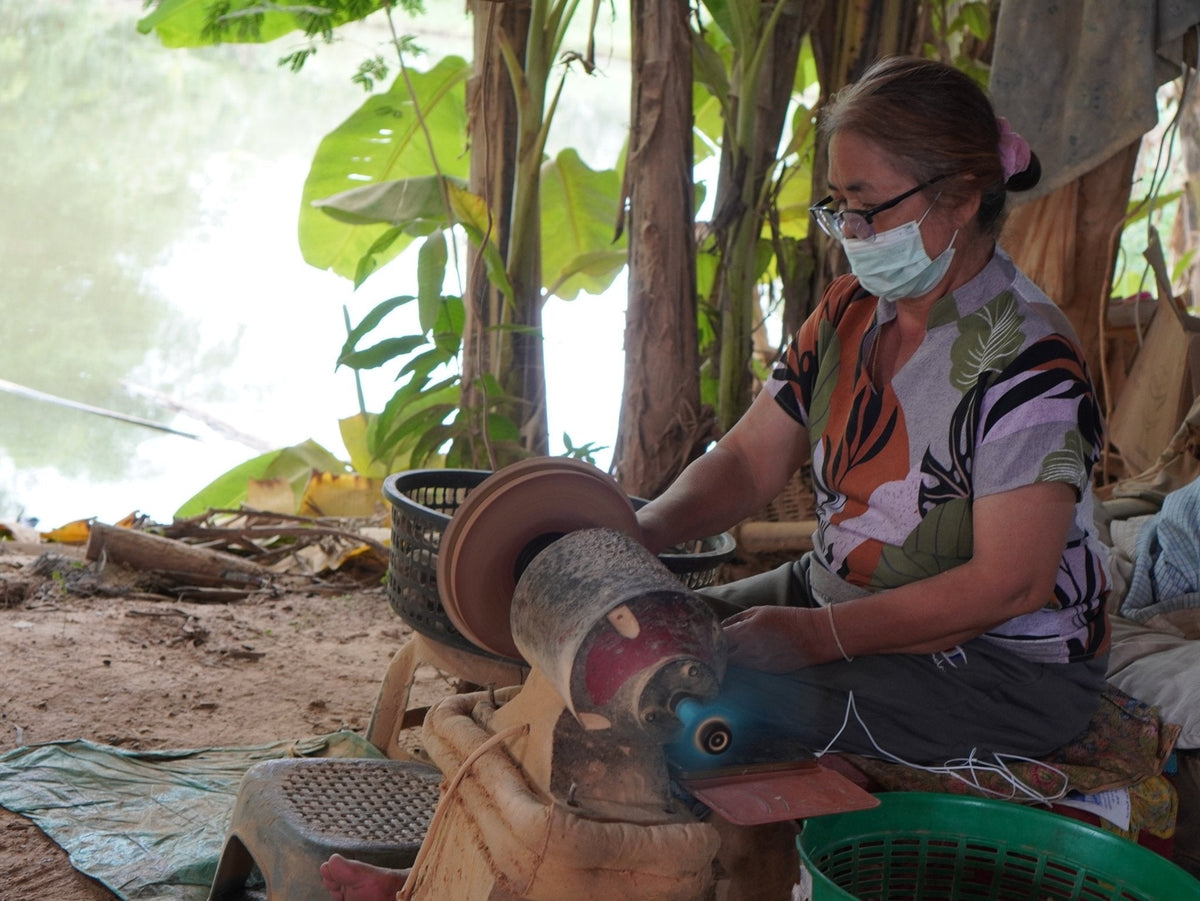
Our pieces are hand-carved from solid teak and left with a natural, unvarnished finish. No seams, no adhesive, and no lacquer to wear through and expose bare grain underneath.
What separates teak from other hardwoods is what's already inside it. The timber carries a high level of natural oil and has a notably tight grain, which is why it was used for ship decking long before anyone made a spoon out of it. Water sits on the surface rather than soaking straight in, and nothing has been applied to achieve that.
It's also denser than bamboo, which you notice the moment you pick one up.
| Teak | Bamboo | |
|---|---|---|
| What it is | Tropical hardwood, carved in one piece | A grass, cut into strips and bonded |
| Construction | No seams, no adhesive | Laminated blank with visible glue lines |
| Water resistance | Natural oil and tight grain | More porous; relies on drying fast |
| In the hand | Heavier, more leverage | Lighter, less hand fatigue |
| How it ages | Dries and greys; oil brings it back | Lifts and splits along the seams |
| Dishwasher | No | No |
What six months of washing up does to each
Both materials survive the first month. The separation shows up around month six, and it shows up at the sink.
Bamboo fails along its seams. Every wash puts water into the laminate, and the glue lines are the weak point. Strips begin to lift, the edge goes rough, and eventually a spatula splits down one of the joins. Leaving a bamboo utensil sitting in a full washing-up bowl accelerates all of it.
Teak dries out instead of coming apart. There are no joins to fail, so the ageing is cosmetic before it is ever structural — the surface loses colour and goes slightly grey. A wipe of food-grade mineral oil every few months brings it back, and the piece underneath is unchanged. Ours are built to outlast the pans you use them on, which is a statement about construction rather than a slogan.
Neither belongs in a dishwasher. Sustained heat and standing water are the worst case for both.

On non-stick pans and cast iron
This is where the two are closest. Both are soft enough to leave a non-stick coating alone, which is the whole reason to reach for wood instead of metal. If that's your only concern, either will do the job.
The differences are in handling. Teak's weight gives you something to push against when you're scraping fond off the bottom of a cast-iron pan, where a light bamboo turner flexes instead. Teak's edge also stays as it was cut, so a spatula keeps a clean working edge for years, while a laminated edge frays as the outer strips wear at different rates.
Neither should be left resting against the side of a hot pan. Wood is wood, and it will scorch.
What you're actually paying for
Six pieces is the point where a utensil crock stops being a compromise. A spoon, a ladle, two spatulas, a turner and a pair of flip tongs cover nearly everything you'd otherwise reach for metal to do.
Bought one at a time, those six add up. As a set, the six pieces cost 47% less than buying them separately — the difference between a considered purchase and an expensive one.
If you'd rather choose your own six, you can build a set piece by piece. And if you're weighing teak against acacia rather than bamboo, we've written that comparison too.
Handmade Teak Wood Kitchen Utensil Set — 6-Piece with Flip Tongs
The six pieces cost 47% less as a set than bought separately.
See the setCommon questions
Is bamboo more sustainable than teak?
On harvest cycle alone bamboo is quicker — it reaches maturity in roughly three to five years and regrows from its existing root system, where a teak tree takes decades. Our teak comes from trees that are replanted and regrown, and not as a policy decision: the artisan families we buy from make their living from this timber, so nobody has a stronger reason to keep a forest standing than the people cutting it. The rest of it is replacement — a utensil that stays in your drawer for a decade takes less out of the world than one replaced every couple of years, whatever it started as.
Can teak or bamboo utensils go in the dishwasher?
No, neither. Sustained heat combined with standing water splits teak and delaminates bamboo. Hand wash both, then dry them properly rather than leaving them to sit on the draining board.
Do teak utensils need oiling?
Occasionally, with food-grade mineral oil. Teak's own oil does most of the work, so this is a few times a year rather than a routine. Wipe it on, leave it to soak in, then wipe off whatever hasn't.
Will either scratch a non-stick pan?
No. Both are softer than the coating, which is why wooden tools are recommended for non-stick, ceramic and enamelled cast iron. Metal utensils are the ones that do the damage.
